Corrected 23 September 2026: every figure on this page was recomputed from the retained audit and Google Maps data. See the note at the end and Dental Website Statistics 2026.
This report covers 455 Texas dental practice websites from our June 2026 automated audit (practices with fewer than 150 Google reviews, where the audit flagged at least two issues), plus Google ratings for 5,592 Texas practices of every size. It is the Texas cut of our State of Dental Websites 2026 report — same method, same checks, read against the same 24-state benchmark of 6,554 sites.
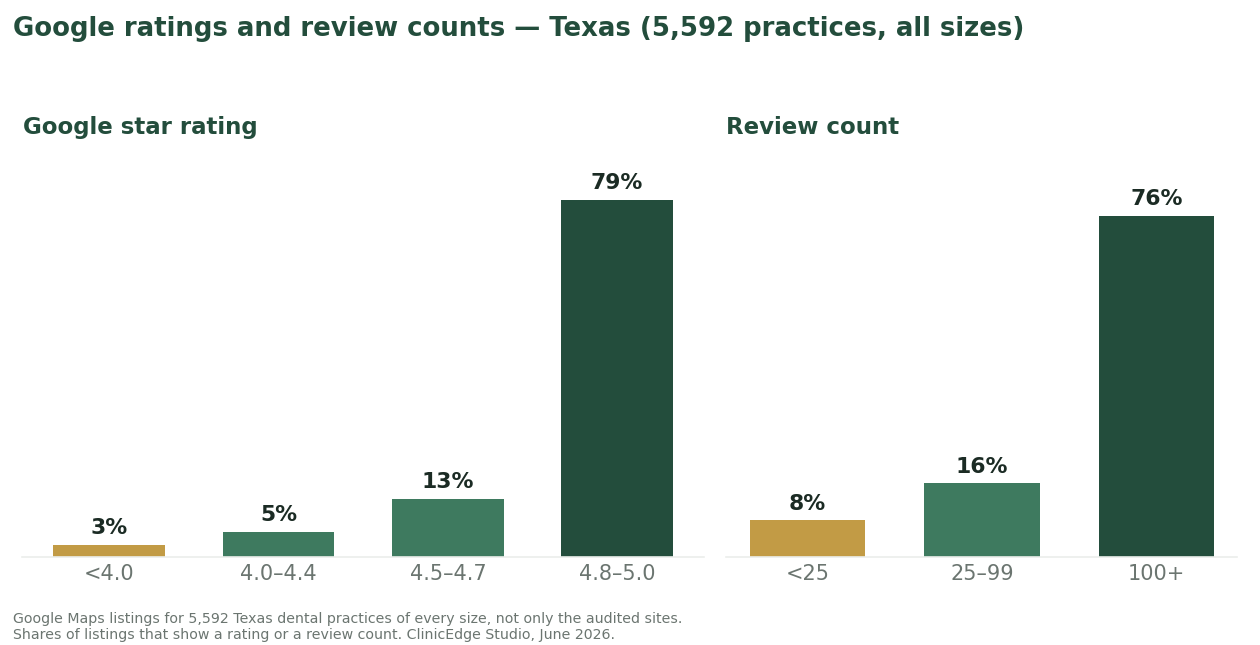
Texas has the highest share of top-rated practices of the eight states: 79% of the Texas practices we mapped on Google are rated 4.8★ or higher, and about three in four have 100+ reviews. Among the audited Texas sites, 16% belong to practices with 50 or more Google reviews that show none of them on the homepage.
The short version for Texas
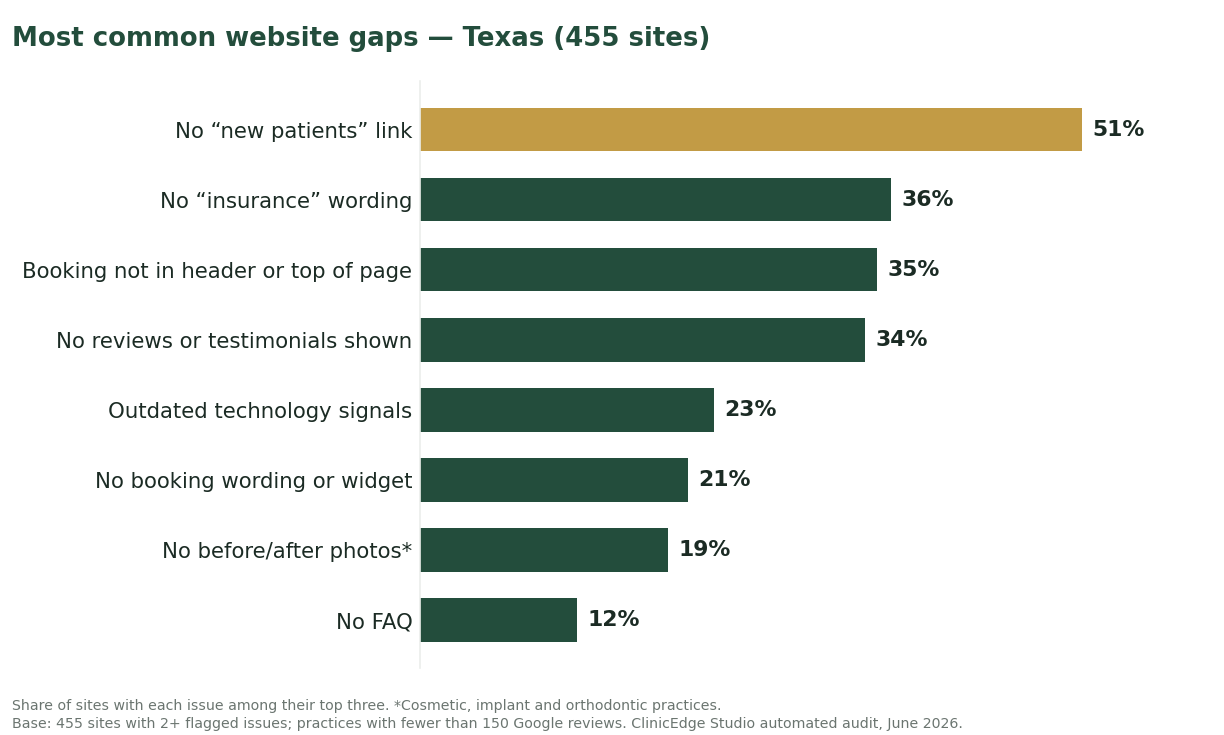
- 51% have no “new patients” link on the homepage or in its menu — a link many first-time visitors look for.
- 36% never use the word “insurance” on the homepage or in its menu.
- 21% have nothing on the homepage labeled for booking or requesting an appointment online, and another 35% have a booking option that is not in the header, the menu or the top of the page.
- 34% show no reviews, star ratings or testimonials on the homepage.
- Across the 5,592 Texas practices we mapped on Google (all sizes, not only those audited), 79% are rated 4.8★ or higher and 76% have 100+ reviews.
The most common gaps in Texas
The leaders aren’t cosmetic. They’re missing answers — “is there a page for me?”, “do you take my insurance?”, “can I book?” — at the moment a patient decides to act.
Texas vs. the 24-state picture
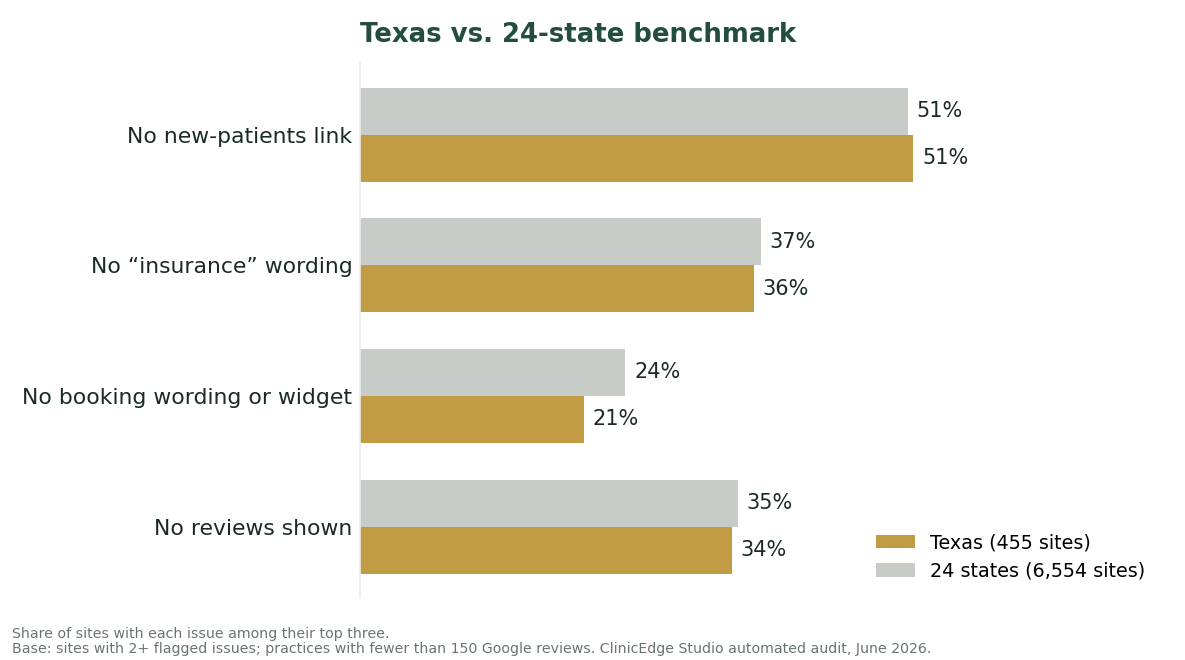
Texas tracks the 24-state benchmark closely on the basics, landing below average on insurance, online booking and showing reviews, and a hair above on the new-patients link — a slightly cleaner profile than the 24-state figures, but the same shape.
The reputation paradox
Here is the tension in the Texas data. Of the 5,592 practices we mapped on Google (all sizes, not only those audited), only 3% are rated below 4.0★ and 79% are rated 4.8★ or higher. And among the audited sites, 16% belong to practices with 50 or more Google reviews that show none of them on the homepage.
A website problem, not a clinical one
Every gap above sits between a patient’s intent and their booking — none of it touches the quality of care. Most of it is content and placement: surface the reviews, insurance answer and new-patient path a Texas practice already has before considering a ground-up rebuild.
If your Texas practice has a strong reputation and a quiet website, the gap between the two is the place to start.
Get your free website audit → · Run your own numbers in our calculator
A note on the numbers. Issue percentages come from ClinicEdge Studio’s June 2026 automated audit: the 455 Texas dental practice websites where the audit flagged at least two issues, counting each site’s top three issues. The audit covered single-location practices with fewer than 150 Google reviews, and leaving out sites with fewer than two flagged issues makes the figures overstate prevalence across all practice websites. With 455 sites, Texas figures carry a margin of error of up to about ±5 points (95% confidence), so differences of a few points between states may not be meaningful. Reputation figures (star ratings and review counts) come from 5,592 Texas practices of every size mapped on Google, most of which were not audited. 24-state figures: the 6,554 such sites across 24 states. All clinics are anonymized. Corrected on 23 September 2026: figures recomputed from the retained audit and Google Maps data; full tables and definitions at Dental Website Statistics 2026.