We audited 6,554 U.S. dental practices, then hand-reviewed nearly 300 of them. The pattern was almost universal: the dentistry is excellent, and the website is quietly turning new patients away.
All clinics are anonymized. Prevalence percentages and audit findings are real, measured data; any visitor- or revenue-based figures are clearly labeled as illustrative models.
The short version
- Across 6,554 audited practices, the single most common mistake is a missing “new patients” page — the one page a first-time visitor looks for. 55% of sites don’t have one.
- The next most common gaps all sit at the moment a patient decides to act: insurance never mentioned (37%), no online booking (27%), and reviews shown nowhere on the site (22%).
- 4 in 5 practices (81%) have at least one problem on the path from “interested” to “booked” — a conversion problem, not a clinical one.
- We found a striking reputation paradox: practices sitting on dozens of genuine Google reviews, showing none of them on their own homepage.
- 94% of audited practices had three or more fixable issues — and almost all are presentation problems fixable in days, not months.
How we did this
We ran an automated audit across 6,554 U.S. dental practice websites in roughly 1,760 towns and cities, checking each for the handful of things that decide whether a ready-to-act patient actually books: a visible way to schedule, social proof, insurance clarity, a clear path for new patients, mobile and speed health, and local-search signals. We then hand-reviewed a cohort of nearly 300 practices our scoring flagged as having high-impact, easily-fixable gaps. Every clinic in this report is anonymized. Prevalence percentages and audit findings are real, measured data. Anywhere we estimate lost visitors or revenue, we label it an illustrative model.
Finding 1 — The most common mistakes are invisible, not ugly
When people picture a “bad” dental website, they imagine clip-art and clutter. The data says the real problems are quieter: missing information and buried actions — friction a patient feels without ever being able to name it. Here is how often each issue showed up across all 6,554 audited practices:
- No “new patients” page — 55%
- Insurance never mentioned — 37%
- No online booking (call-only) — 27%
- Reviews not shown on the site — 22%
- No before/after photos — 12%
- No FAQ page — 11%
- Dated / old-looking website — 10%
- Mobile or speed problems — 6%
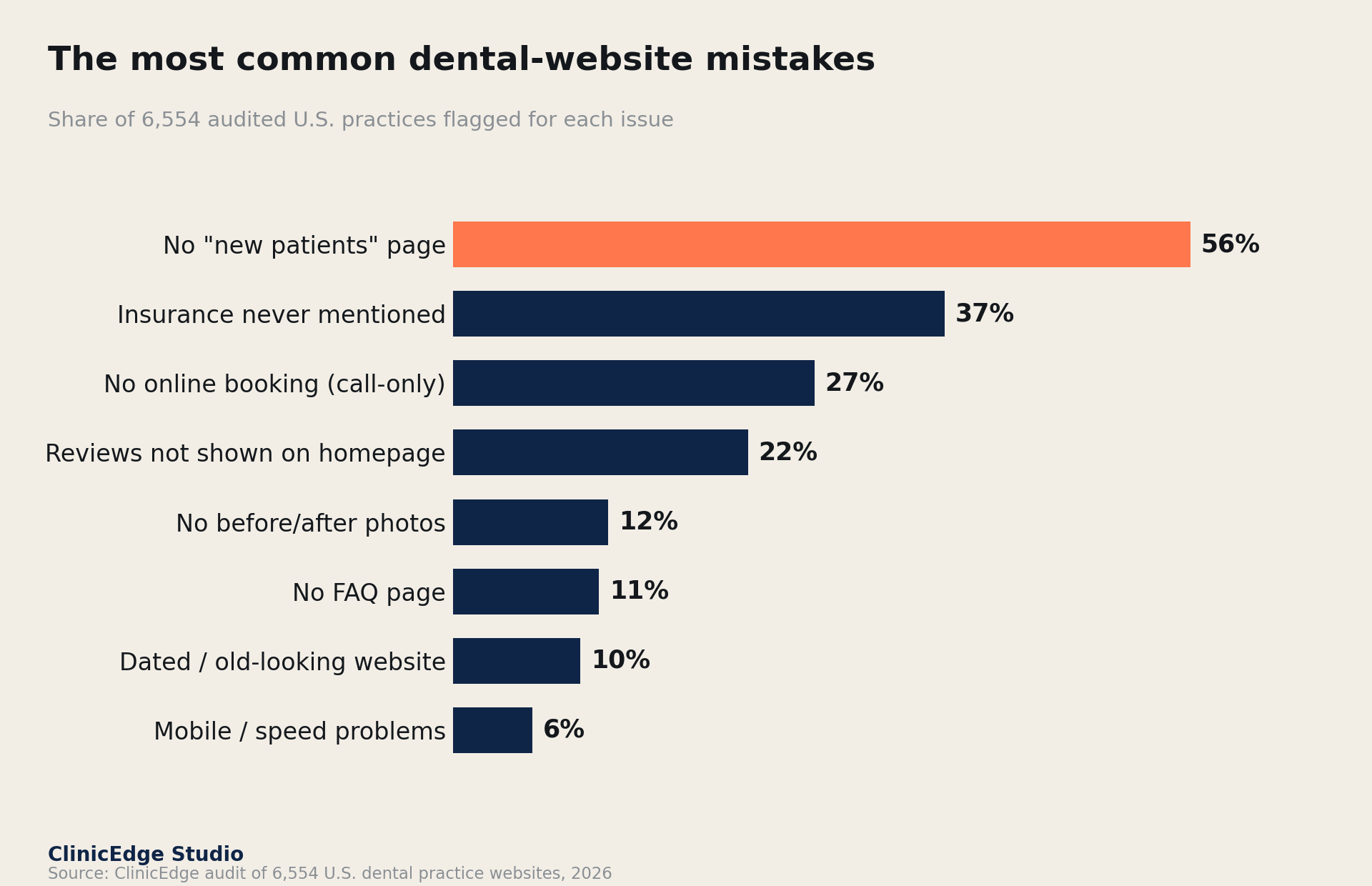
Two things stand out. First, the leaders are not cosmetic — they are missing answers (“is there a page for me?”, “do you take my insurance?”, “can I book?”) at the exact moment a patient decides to act. Second, the genuinely cosmetic complaint — a “dated” site — is real, but it ranks well below problems most owners don’t even know they have.
Finding 2 — The booking path is a top leak
More than a quarter of practices (27%) give a motivated visitor no way to book online at all — every appointment is forced through a phone call during office hours, which silently loses every evening and lunch-break browser. Others have booking, but bury it where the most motivated visitor has to hunt for the one thing they came to do.
It is worth sitting with how self-defeating that is. These practices pay, in time or ad spend, to get a ready-to-book patient onto the page — then make booking the hardest thing to find. The journey from intent to a booked visit has only a few steps, and a single broken step leaks the people most likely to convert.

Finding 3 — The reputation paradox
This was the finding that surprised us most. Over and over, we found practices that had already done the hard, slow work of earning a great reputation — and then hid it. We catalogued practices sitting on 50 to nearly 150 genuine Google reviews, with star ratings most clinics would envy, and not one of those reviews appeared on their homepage. A first-time visitor — the exact person the proof is for — sees a blank wall.
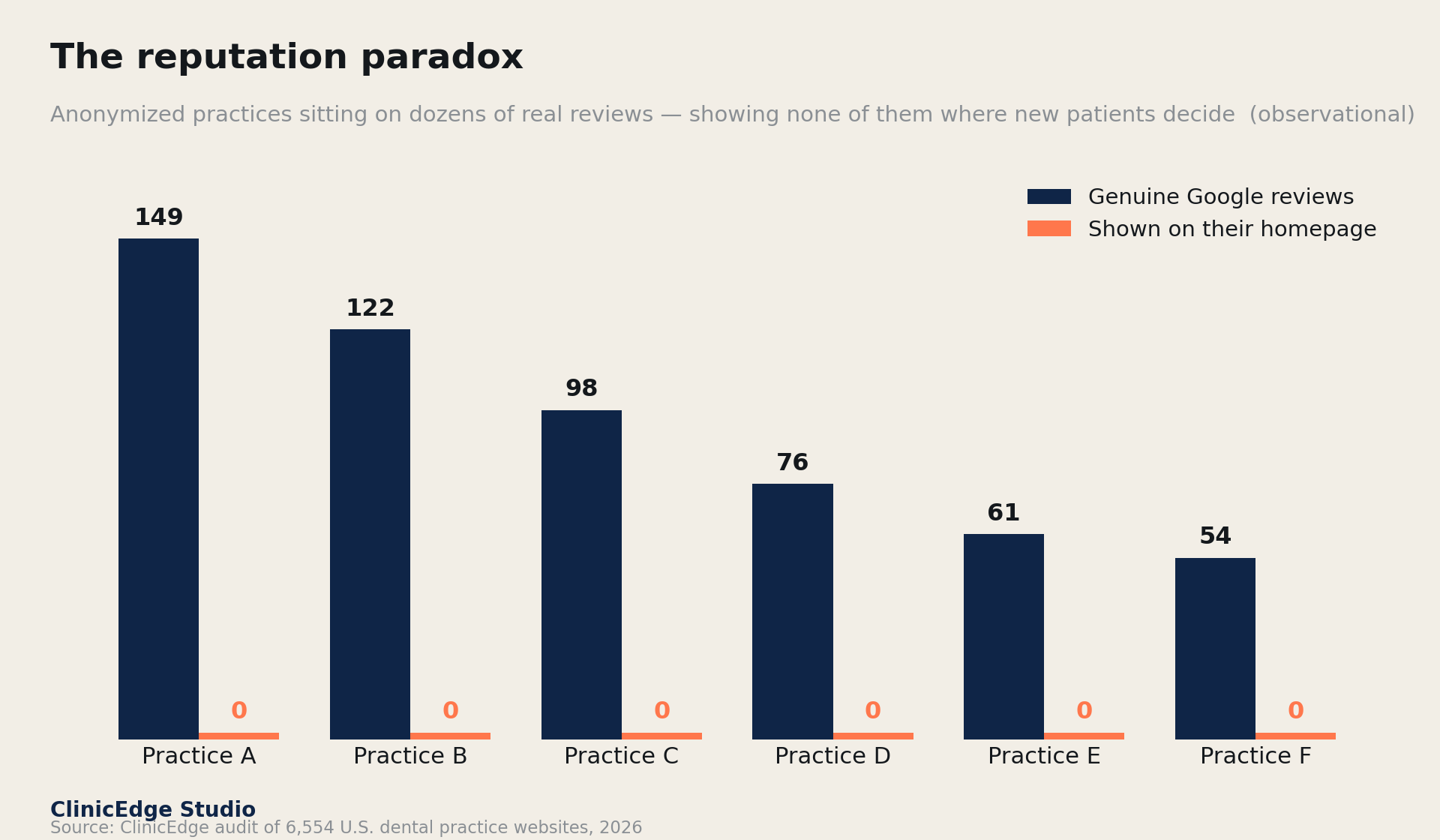
A new patient doesn’t yet know the practice is excellent; social proof is how they find out in the three seconds before they decide. A homepage with no stars, no count and no patient quotes makes 149 five-star reviews do precisely zero work where the decision is actually made.
Finding 4 — It’s a conversion problem, not a clinical one
Group the issues by what they actually cost a practice and the picture gets clearer. Four out of five audited practices (81%) have at least one problem on the conversion path — booking, insurance clarity, or new-patient information. Far fewer have problems that are purely technical or cosmetic.
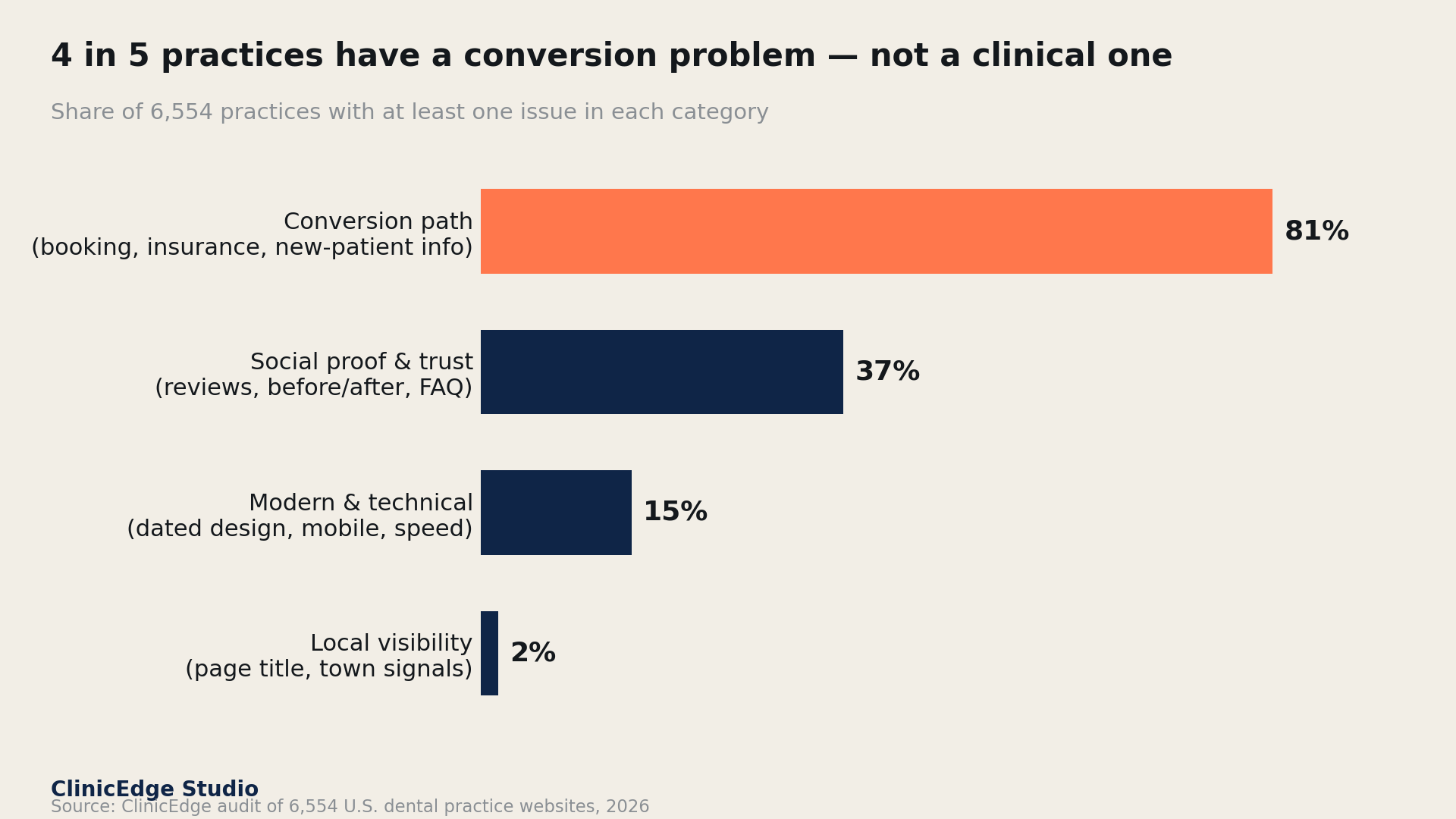
The rest of the audit fills in around that core. Reviews, before/after photos and FAQs — the social-proof layer — are missing on more than a third of sites. Genuinely dated builds (about 10%), slow load times and pages that fight a phone (around 6%) are real but less common than most owners fear. And a small but frustrating few (roughly 2%) send muddy local-search signals — a homepage whose title reads “Home” instead of naming the town and the word “dentist,” quietly ranking below the practices that do.
The pattern: great practices, leaky websites
Read across all 300 cohort practices and the throughline is identical. These are not struggling clinics with bad dentistry. They have strong ratings, loyal patients and real reputations. The website is the bottleneck — not the work. Three things repeat:
- The problems are conversion problems, not clinical ones. Every gap sits between a patient’s intent and their booking — none of it touches the quality of care.
- The mistakes are common, not exotic. A missing new-patients page, buried booking, hidden reviews, insurance silence — each shows up in a large share of all clinics, which is exactly why they’re so easy to miss.
- The fixes are mostly presentation. Surfacing what a practice already has — its reviews, its results, its booking — usually beats a ground-up rebuild.
The good news: most of this is fast to fix
The encouraging part of the data is how shallow most of these problems are. A large share are same-week fixes: adding a clear new-patients page, surfacing a booking button, pulling live Google reviews onto the homepage, adding a short insurance line, writing a page title with your city and “dentist.” A smaller group — genuinely dated, slow or non-mobile sites — call for a modern rebuild, but even then the content already exists; it just needs a current foundation. Almost always, the smart order is to surface the assets you already have before rebuilding anything.
If your practice has a strong reputation and a quiet website, the gap between the two is the opportunity — and it’s usually a week of focused work, not a rebuild.
Where to start
If you want to know which of these gaps your own site has, that’s exactly what our audit checks. We’ll show you the same things we measured here — a clear new-patients path, booking visibility, on-page social proof, insurance clarity, mobile and speed health, and local-search signals — and tell you which fixes are quick wins and which (if any) warrant a rebuild. The findings are yours to keep.
Curious what these gaps are costing you in missed bookings? Our lost-revenue calculator gives you a ballpark in two minutes.
A note on the numbers. Prevalence percentages are drawn from ClinicEdge Studio’s audit of 6,554 U.S. dental practice websites across roughly 1,760 towns and cities, 2026. Cohort observations describe a hand-reviewed sample of nearly 300 practices our scoring flagged as high-opportunity, so they reflect practices with fixable gaps rather than a random national sample. Prevalence figures and audit findings are real; any visitor or revenue figures, where used, are illustrative models. All clinics are anonymized.