


Most clinic websites waste their most-read real estate on sentiment, not conversion. Here's exactly how US practices write copy that books patients.
Learn More


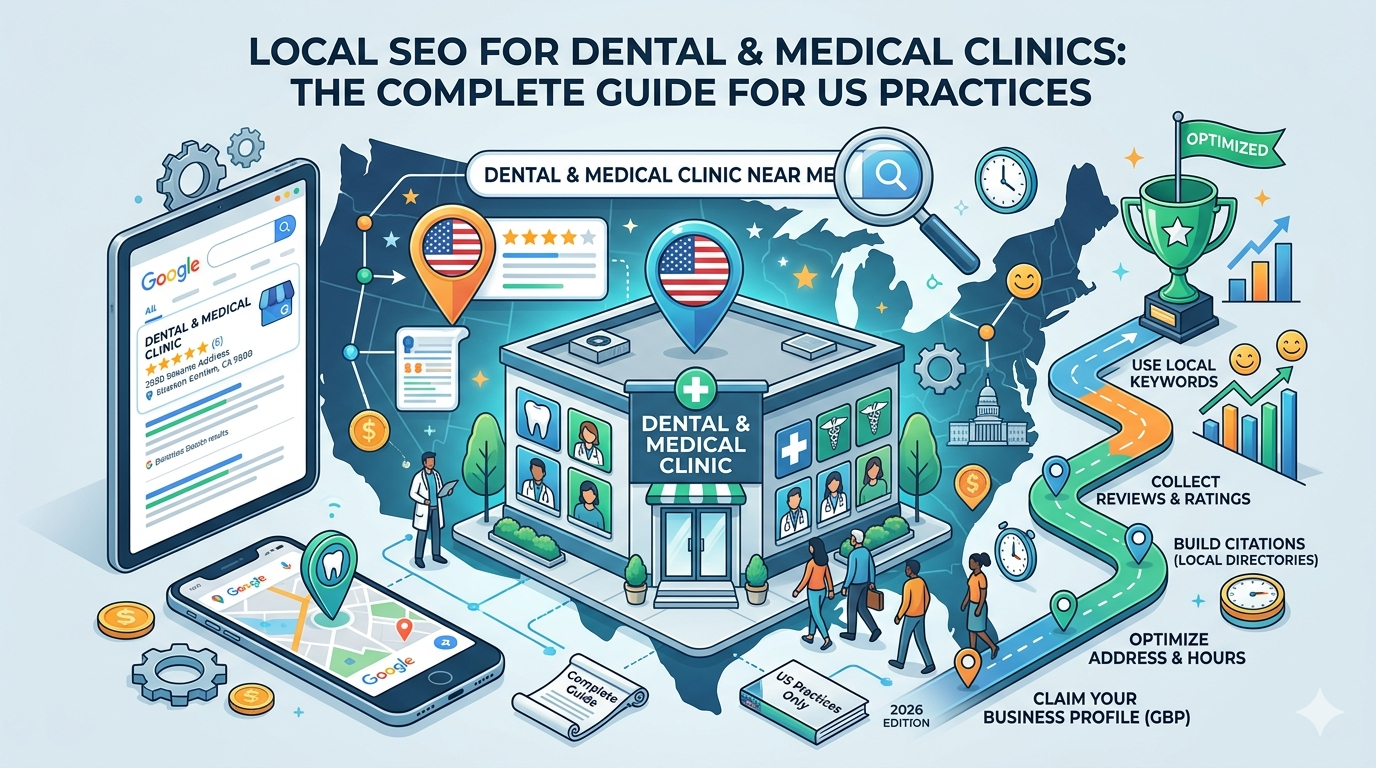
I was reviewing a dental practice's Google Analytics last September — a well-established GP clinic in Austin, 12 years in operation, a full appointment book in 2019. The practice manager had brought me in because new patient numbers had been declining for 18 months. She thought it might be the area demographics shifting.
It wasn't.
When I pulled up their Google Business Profile, the listing hadn't been updated since 2021. The photos were from the old location — they'd moved. The hours were wrong. And when I searched "dentist near me" from the clinic's own parking lot, they weren't in the local pack. A practice that opened last year — two blocks away — was ranked above them.
Eighteen months of declining new patients. The answer was visible in thirty seconds.
Local SEO isn't a technical mystery. It's the discipline of making your clinic visible to patients searching for what you offer, in the area you serve, at the moment they're ready to book. Most US clinics either ignore it entirely or treat it as a one-time setup task. Both approaches are expensive.
This guide covers exactly how dental and medical clinics dominate local search — and keep that position.
46% of all Google searches have local intent (Google Search data, via Search Engine Land, 2022). Nearly half of every search performed on Google is someone looking for something near them. For healthcare, that percentage is even higher.
72% of US adults have searched online for health information (Pew Research Center, 2021). The starting point for most healthcare journeys isn't a GP referral or an insurance directory. It's a search bar. The question is whether your clinic shows up in the answer.
Practices ranked in Google's local 3-pack receive 126% more calls than those ranked outside it (Dental Economics, 2022). The local 3-pack captures a disproportionate share of all clicks. Position 4, just outside the pack, might as well not exist.
Here's what those numbers mean in practice. A dental clinic in a metro area, currently not ranking in the local 3-pack, is competing for patients with a fraction of the visibility of the practices above them. A 50% improvement in local search ranking — achievable with the framework in this guide — can mean 30–40 additional new patient inquiries annually without any increase in advertising spend.
Local SEO isn't a marketing add-on. It's the infrastructure your patient acquisition depends on.
Your Google Business Profile (GBP) is the single most impactful local SEO asset a clinic has. More important than the website for many local searches. More important than reviews. More important than content.
And most clinic GBP listings are a mess.
NAP consistency — the alignment of Name, Address, and Phone number across your GBP, website, and every directory where your practice appears — is the foundational ranking signal Google uses to verify a business is legitimate and correctly located. One digit wrong in a phone number across 40 citations is enough to suppress rankings.
The specific GBP optimisation steps that move the needle:
This is something I observed during a clinic rotation in late November — a family medicine practice in Denver had 87 reviews averaging 4.8 stars. Excellent. But the services section was completely empty and they had no secondary categories set. Two nearby competitors with fewer and lower-rated reviews were outranking them for "family doctor near me" because their GBP infrastructure was more complete. Stars aren't everything. Structure matters.
Not sure if your GBP passes these checks? I built a 2-minute checklist specifically for this →
Your website is the second pillar of local SEO authority. Most clinic websites are either invisible to local search signals or actively working against rankings.
The on-page signals that matter most:
For the full technical picture on how website design affects these signals, our complete guide to medical clinic website design covers the design decisions that directly affect local ranking.
Reviews are both a ranking signal and a conversion factor. Google uses review velocity, volume, and sentiment as inputs to local ranking. Most practices collect reviews by waiting and hoping.
A systematic review strategy:
Most clinic owners miss this until Q4. Grab the quick fix →
A local citation is any online mention of your practice's NAP. Google cross-references citations across directories to verify your business location and legitimacy. The more consistent, the stronger your local authority.
Priority directories for US healthcare clinics:
The mistake most practices make: listing on hundreds of low-quality directories while having inconsistencies in the top 10. Quality and consistency beat volume every time.
For the cluster-level content that supports citation building, local SEO for clinics — ranking for "near me" searches covers the proximity-based signals that determine who appears when patients search with immediate booking intent.
Local content means creating pages targeting location-specific search terms your patients actually use. Not "dental implants" — that's a national keyword you can't compete for. "Dental implants in [City]," "emergency dentist [Neighbourhood]," "family dentist accepting new patients [City, State]" — achievable, high-converting search terms for a single practice.
The content strategy that works:
For the compounding logic behind consistent content investment, why dentists need a strategic SEO plan explains why the practices with growing organic traffic treat SEO as infrastructure, not a campaign.
Why it happens: Someone set up the GBP listing three years ago. It looks complete. Nobody touches it.
Why it costs patients: Google's local algorithm actively favours recently updated, actively managed listings. A static GBP from 2021 — even a complete one — gradually loses visibility to competitors adding photos, updating hours, and collecting fresh reviews every month.
The fix: Assign GBP management to a specific team member with a monthly checklist: one new photo, check hours, respond to any new reviews, check Q&A for unanswered questions. Fifteen minutes per month.
Why it happens: The practice moved or changed its phone number — and updated Google but not the 40 other places the old information lives.
Why it costs patients: NAP inconsistency confuses Google's verification process and actively suppresses rankings. A practice with 200 citations where 60 have an old address is telling Google two different stories about where it exists.
The fix: Run a citation audit via Moz Local, BrightLocal, or Whitespark. Find every inconsistency. Fix systematically, starting with the highest-authority directories.
Expected outcome: Practices that clean up NAP inconsistencies typically see local pack ranking improvements within 60–90 days.
Why it happens: Keyword research tools focus on volume — and "dentist [city]" has more monthly searches than "dentist near me" in absolute numbers.
Why it costs patients: "Near me" searches are hyper-intent queries. The patient is actively searching to act immediately. They're usually on mobile, often in pain, booking with whoever appears. Local SEO for clinics — ranking for "near me" searches covers the specific optimisation steps for capturing these searches.
The fix: Your GBP primary category, service descriptions, and page titles all need optimisation for proximity-based queries — not just keyword-based ones.
Why it happens: Google Analytics shows overall organic traffic. Practices assume it tells the full story.
Why it costs patients: A practice ranking #2 nationally for "teeth whitening" and #18 locally is invisible to the patients it can actually serve. 5 expert local SEO hacks for dental clinics covers the specific tracking setup that makes local position monitoring manageable.
The fix: Track Google Business Profile insights weekly and use BrightLocal or Semrush to track local pack position for your 10 highest-value local keywords.
These posts go deeper on specific components of the local SEO system this guide covers.
For the mechanics of ranking for highest-intent local searches: local SEO for clinics — ranking for "near me" searches breaks down the GBP and on-page signals that determine who appears when a patient searches with immediate booking intent.
If you're evaluating SEO service providers: dental SEO services — what you're actually buying explains what legitimate local SEO work looks like, what to ask for, and what to walk away from.
For the compounding-returns case for consistent SEO investment: why dentists need a strategic SEO plan makes the infrastructure argument that changes how practices think about search.
For quick tactical wins before going deep: 5 expert local SEO hacks for dental clinics covers five GBP and on-page changes that typically show results within 30 days.
Local SEO is the practice of optimising your clinic's online presence — Google Business Profile, website, and directory listings — so your practice appears when patients in your area search for the services you offer. For dental and medical clinics, it primarily means ranking in Google's local 3-pack and in organic results for location-specific terms like "dentist in [city]" or "family doctor near me."
Most clinics see measurable improvements in Google Business Profile visibility within 30–60 days of consistent optimisation. On-page SEO changes typically take 60–120 days to fully register in rankings. The practices that see the fastest results start with GBP optimisation and NAP consistency — both are faster-moving signals than website SEO.
A well-structured local SEO engagement for a single-location practice typically runs $500–$1,500 per month depending on market competition and scope. The better question is cost per new patient acquired — practices tracking this consistently find local SEO delivers lower cost-per-acquisition than paid advertising within 6–12 months.
The foundational work — GBP optimisation, NAP cleanup, on-page title tags, schema markup — can be handled in-house with the right guidance. Ongoing content, citation building, and competitive tracking benefit from professional support in competitive markets. Most practices do well starting in-house, identifying their biggest ranking gaps, and bringing in support for the ones they can't close alone.
SEO builds organic visibility that compounds over time without per-click costs. Google Ads delivers immediate visibility but stops the moment you stop paying. The practices with the most stable patient acquisition pipelines use both: SEO as the long-term foundation, paid ads to capture immediate opportunities during growth phases or seasonal peaks.
Most clinics have local SEO gaps they don't know about. Wrong GBP category. NAP inconsistency suppressing rankings. Empty services section. Photos from a location you left two years ago.
These aren't hard to fix. They're just invisible until someone runs the checks.
I find the top three local SEO leaks for clinic websites in every free audit — no agency pitch, no retained services required. Just the specific changes that will move your rankings, based on your market and your current setup.
Slots are limited each month.

Get a free 15-minute website audit to see how we can help your clinic fill appointment books, reduce no-shows, and convert more visitors into booked patients just like the clinics we’ve worked with.
kindly insert your email below to recieve our Clinic website optimization guide explaining tips that can make your website super optimized to maximumize patient booking and patient aquisation
Our Blogs
Most clinic websites waste their most-read real estate on sentiment, not conversion. Here's exactly how US practices write copy that books patients.
847 clicks. 4 new patients. Most clinic Google Ads campaigns are structured for traffic, not conversions. Here's the exact setup that actually fills appointment slots.
Connect with our team to build a high-converting clinic website. Learn More


