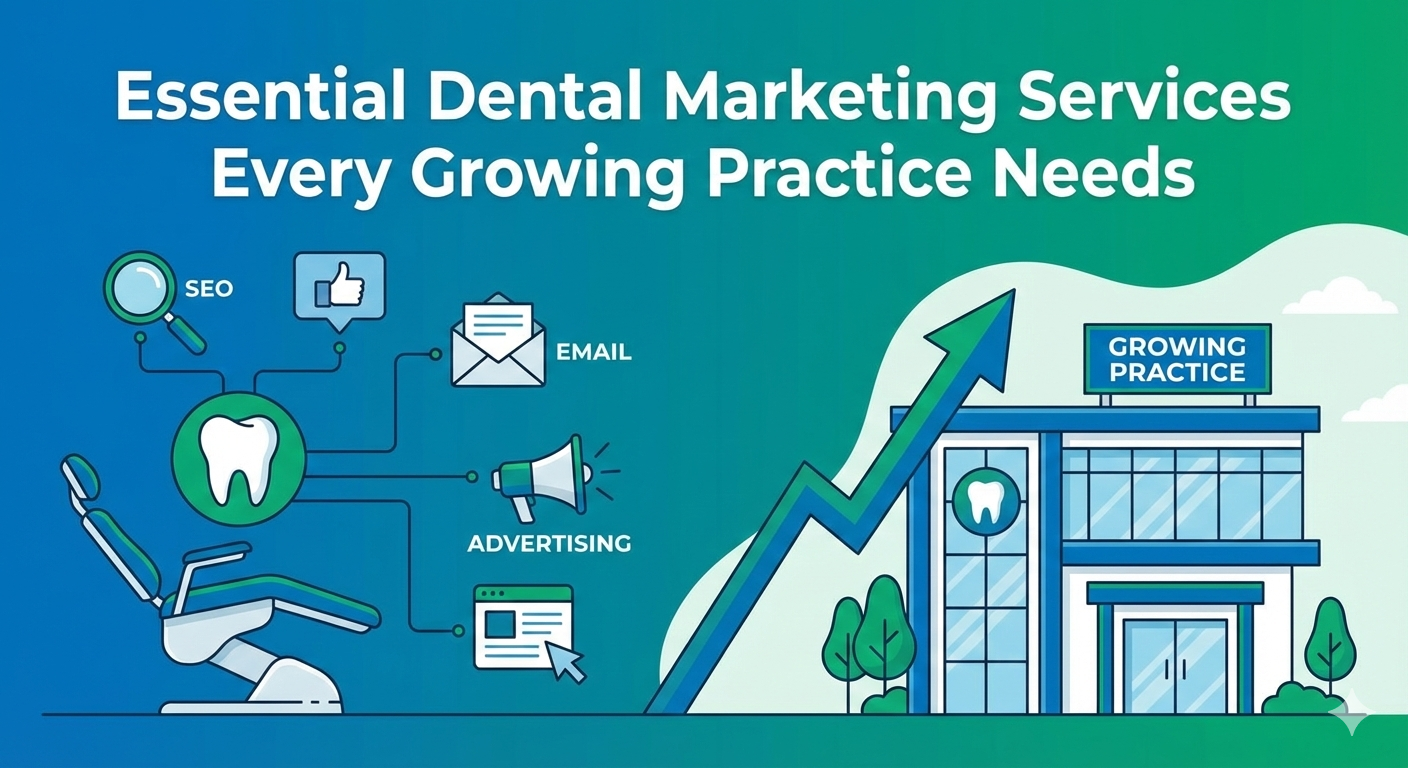
A growing dental practice doesn't need every marketing service available. It needs the right services, executed consistently, in the right order. I've watched practices subscribe to eight different marketing tools and see zero meaningful new patient growth because each channel was running in isolation, none were properly attributed, and the budget was too diluted to make any single channel competitive.
The practices growing fastest aren't doing more. They're doing fewer things better, and they know exactly which services are essential at each stage of growth vs. which are optional enhancements that can wait until the core system is working.
Here's the essential dental marketing services stack, organized by growth stage.
The Non-Negotiable Foundation Services (Every Practice, Every Stage)
- Google Business Profile management: Weekly posts, consistent NAP, photo updates, Q&A populated, review response. This is not a one-time setup. It requires ongoing maintenance to hold rankings. The foundation of every other local marketing effort rests on a healthy GBP.
- Website with converting booking flow: Professional, mobile-optimized, with a single primary CTA, trust signals above the fold, and a booking form with fewer than 4 fields. The copywriting framework that makes your website convert is covered in the Healthcare Website Copywriting pillar guide.
- Review acquisition system: A process, not just a hope. Direct review link, text message to patients within 4 hours of appointment, follow-up for non-responders. Managed consistently, this builds the social proof that makes every other marketing channel more effective.
- Citation consistency management: Annual audit of your NAP across the top 30 healthcare directories. Not glamorous. Absolutely necessary for local SEO performance.
Phone Call Tracking: The Attribution Service Almost No Dental Practice Uses
The specific service that opens up genuine multi-channel marketing attribution: phone call tracking. A platform like CallRail or CallTrackingMetrics assigns different phone numbers to different marketing channels, your Google Ads landing page gets one number, your website gets another, your direct mail postcard gets a third. When a patient calls, the platform records which number they dialed, which source generated the call, and how long the call lasted.
The operational value: you know specifically that Google Ads generated 14 calls last month, your website generated 8, and your mailer generated 6. You know which ad groups are generating calls vs. which ones are burning budget on clicks that never call. Call tracking costs $50 to $150 per month. For a practice spending $1,500+ per month on advertising, knowing specifically which campaigns are generating patient enquiries is worth multiples of that cost in budget optimization alone.
See It In Action
The multi-channel attribution setup I built for a growing medical clinic, including call tracking, form submission tracking, and source attribution for new patients, is documented in the General Medical Clinic Patient Flow Simulation case study. The approach gives practices the data infrastructure to make confident marketing budget decisions.
The Growth-Stage Services Stack
Stage 1 (0-$500k production): Foundation + Acquisition basics
- GBP management (in-house, ~2 hours/week)
- Review acquisition system (process only)
- Google Ads management (agency, $500-$1,000/month management fee)
- Phone call tracking ($50-$100/month)
- Website with booking flow (one-time cost)
Stage 2 ($500k-$1M production): Foundation + SEO + Retargeting
- All Stage 1 services
- Local SEO and content strategy
- Meta Ads retargeting ($300-$800/month ad spend)
- Email recall campaigns (quarterly)
- Referral system
Stage 3 ($1M+ production): Full multi-channel system
- All Stage 2 services
- In-house marketing coordinator (part-time or full-time)
- Pillar content and cluster blog authority building
- Direct mail for geographic saturation
- Google Local Services Ads
- Advanced analytics dashboard with new patient attribution reporting
For how to evaluate whether you need an agency or in-house team to deliver these services, see hiring a dental marketing consultant: red flags and green lights. For how much budget to allocate at each stage, how much dentists spend on marketing in 2026 covers the benchmarks. According to ADA Health Policy Institute research, dental practices with diversified marketing portfolios (three or more patient acquisition channels) show significantly lower new patient acquisition costs over time compared to single-channel practices.
What to Do This Week
- Identify which stage of the services stack above your practice currently matches. Are you missing any non-negotiable foundation services?
- Evaluate whether you have phone call tracking in place, if not, sign up for a call tracking trial this week
- Check whether your review acquisition system is actually systematic or whether reviews are happening accidentally
- List your current marketing services and their monthly cost. Is the budget concentration in the right places for your growth stage?
- Set a 30-day goal to have phone call attribution data in place so your next marketing budget decision is data-driven
If you want help identifying exactly which marketing services your practice needs at its current stage, book the free 15-minute clinic website audit. I'll look at your current setup and give you a specific recommendation for what to add, what to cut, and what to prioritize.
Frequently Asked Questions
What's the minimum marketing services investment for a dental practice to grow?
The minimum effective investment for meaningful new patient growth: a functioning website ($1,500 to $5,000 one-time), GBP management (in-house, ~2 hours/week), a review acquisition system (process cost), and Google Ads management ($500 to $1,200/month management fee plus $1,000 to $2,000/month ad spend). Below this foundation, growth happens very slowly.
Which dental marketing service has the best ROI?
For established practices with an existing patient database, email recall campaigns have the highest ROI because they reactivate patients who already know and trust you. For new practices building from scratch, Google Ads with call tracking has the fastest path to measurable patient acquisition ROI. Local SEO has the best long-term ROI but requires 6 to 18 months to build.
Should a dental practice use a single marketing service or multiple channels?
Multiple channels, coordinated. A dental practice relying on a single marketing channel is one algorithm change or one competitive move away from a patient acquisition crisis. The most resilient patient acquisition systems have two to four channels running simultaneously, with each reinforcing the others' effectiveness.
What dental marketing services should I cut if I need to reduce spending?
If new patient volume has flattened and you cannot tell whether the problem is the site, the channels, or the offer, that diagnosis is the audit. I will spend 15 minutes with your site, your GBP, and your ad accounts and tell you which one to fix first. clinicedgestudio.com.