Most dentists learn about teeth for eight years and spend approximately zero hours learning how to market a dental practice. Then they open their doors and discover that "building it" does not mean patients will come. The new patient pipeline is entirely their problem to solve, and nobody in dental school gave them a framework for it.
I work with dental and medical clinic owners at ClinicEdge Studio, and the single most common situation I encounter is a skilled clinician who built a genuinely good practice and then watched it grow slowly, or not at all, because they didn't understand which marketing channels work for dental clinics, in what order, and at what budget level.
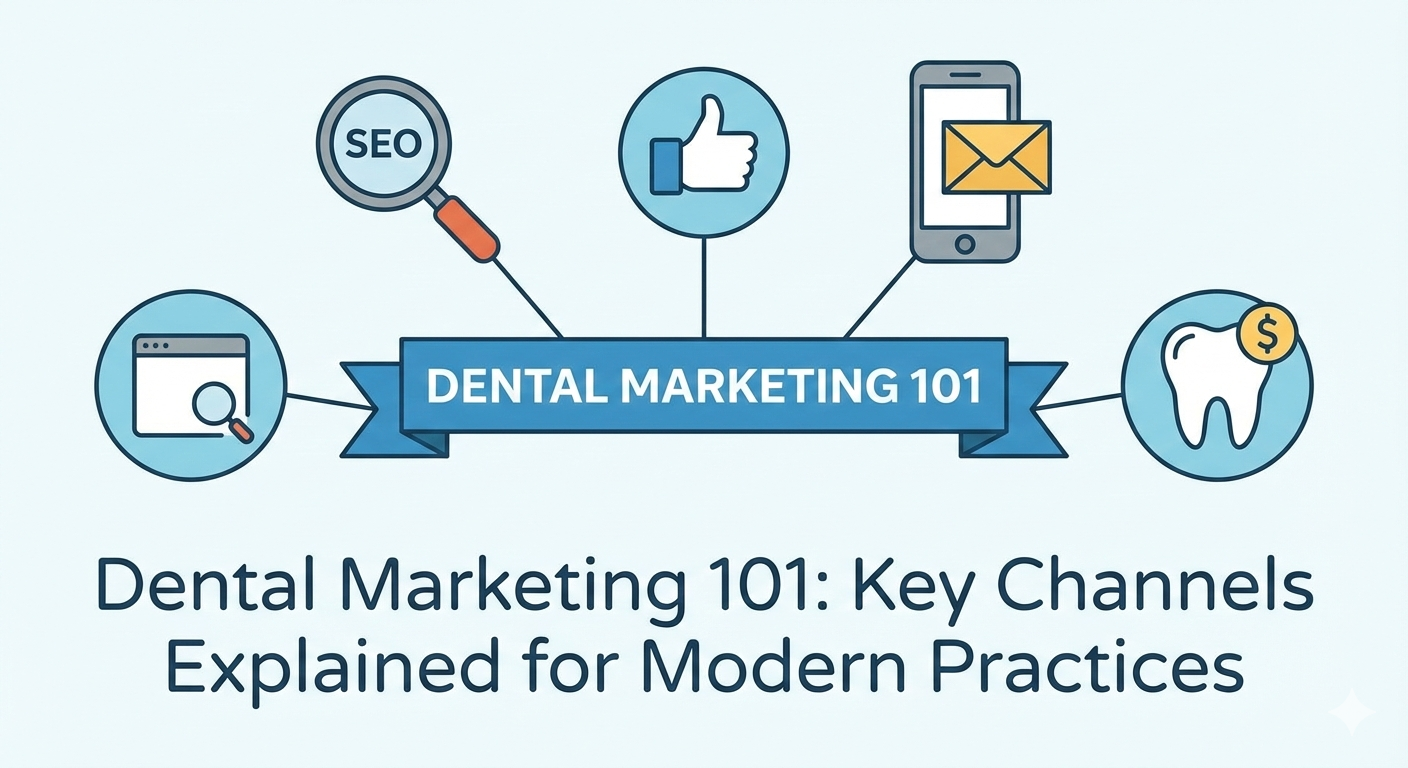
Here's the dental marketing 101 framework that gives you a clear picture of what channels exist, what each one does, and how to think about building a patient acquisition system rather than running disconnected tactics.
The Three Layers of Dental Marketing
Dental marketing operates on three layers that work together:
- Foundation layer (can't be skipped): Google Business Profile optimization, a website with a converting booking flow, and citation consistency across directories. This is the infrastructure that determines whether your marketing spend works or doesn't. Weak foundation means every campaign underperforms.
- Acquisition layer (fills the pipeline): Google Ads for intent capture, local SEO for organic visibility, and Meta Ads for awareness and retargeting. These are the primary channels for generating new patient enquiries.
- Retention layer (protects lifetime value): Email recall campaigns, review acquisition systems, referral programs, and patient reactivation. These channels are dramatically underinvested by most dental practices and consistently underestimated in their ROI.
Most dental marketing discussions focus entirely on the acquisition layer. Most dental marketing problems live in the foundation layer. And most dental marketing budget is wasted because practices skip the foundation and go straight to paid advertising before their website and GBP can convert the traffic those ads generate. The messaging and positioning framework that ties all three layers together is covered in the Healthcare Website Copywriting pillar guide.
Google Business Profile Posting: The Local Visibility Lever Most Clinics Ignore
Here's a specific finding that most dental marketing advisors underemphasize: practices that post weekly to their Google Business Profile consistently outrank those that don't, holding all other factors equal. GBP posts, brief updates, offers, patient tips, team highlights, signal to Google that the business is active and engaged. An inactive profile signals the opposite.
A dental practice posting weekly GBP updates, maintaining steady review velocity, and populating all GBP fields builds local map pack authority faster than practices investing five times more in Google Ads without this foundation. A 30-minute weekly investment in GBP activity is often worth more in local ranking movement than $500 in paid advertising.
The Channel Priority Stack for New Practices vs. Established Practices
New practice marketing priority:
- GBP setup and optimization (week 1)
- Website with booking flow (week 1)
- Google Ads for immediate patient acquisition (month 1)
- Citation building and review acquisition system (month 1)
- Content/SEO (month 3+)
- Meta Ads for retargeting (month 3+)
Established practice marketing priority:
- Local SEO and GBP optimization (for lower cost per patient than paid)
- Review velocity maintenance
- Email recall campaigns for lapsed patients
- Referral system
- Google Ads for high-value service campaigns (implants, Invisalign)
- Content authority building
For the specific digital marketing strategies for established practices, see essential dental marketing services every growing practice needs. For how marketing services work together as a system, essential dental marketing services covers all channels as an integrated framework.
What Dental Marketing Budget Actually Looks Like
According to ADA Health Policy Institute research, dental practices typically allocate 2% to 5% of production revenue to marketing. A practice producing $600,000 per year should be investing $12,000 to $30,000 annually. $1,000 To $2,500 per month. New practices and practices in competitive markets often need the higher end of that range to generate sufficient new patient volume. Concentrated investment in two to three channels done well consistently outperforms scattered investment across six channels done poorly.
What to Do This Week
- Audit your GBP. Is every field complete? When did you last post an update?
- Map your current marketing channels. Which are you actively investing in? What's producing results?
- Calculate your current marketing spend as a percentage of production revenue. Are you above or below 2%?
- Identify which layer (foundation, acquisition, retention) is your current weakest point
- Set up a GBP post schedule for the next 4 weeks and batch the content in one sitting
If you want a clear picture of where your specific practice's marketing is underperforming and what to prioritize first, book the free 15-minute clinic website audit. I'll look at your foundation, acquisition channels, and retention systems and give you a prioritized action plan.
Frequently Asked Questions
See It In Action
Want to see how a real medical clinic applied these principles? Read the General Medical Clinic Patient Flow Study for a data-backed look at what happens when the right strategy meets consistent execution.
What's the most important dental marketing channel for a brand new practice?
Google Ads for immediate patient acquisition, combined with GBP optimization. New practices need patients now. Organic SEO takes months to produce results. Google Ads with call extensions and a proper landing page can generate patient enquiries within the first week of a campaign going live.
How long does it take for dental marketing to work?
Paid advertising can generate results within days. Local SEO takes 3 to 6 months to show meaningful movement. Content authority takes 9 to 18 months to compound into a significant organic patient acquisition channel. The most sustainable systems use all three in sequence, starting with paid acquisition to build cash flow while investing in longer-term channels.
Do I need a marketing agency or can I do dental marketing myself?
The foundation layer (GBP optimization, citation building, review management) is absolutely DIY-able. Google Ads management requires more expertise to execute well. Poorly managed campaigns waste budget quickly. Most growing practices outsource Google Ads and content while managing GBP and reviews internally.
What's the biggest dental marketing mistake practices make?
If your homepage headline could belong to any clinic in your city, it is costing you patients in the first seven seconds. I will rewrite the first three lines of your homepage as part of a free 15-minute audit. clinicedgestudio.com.